
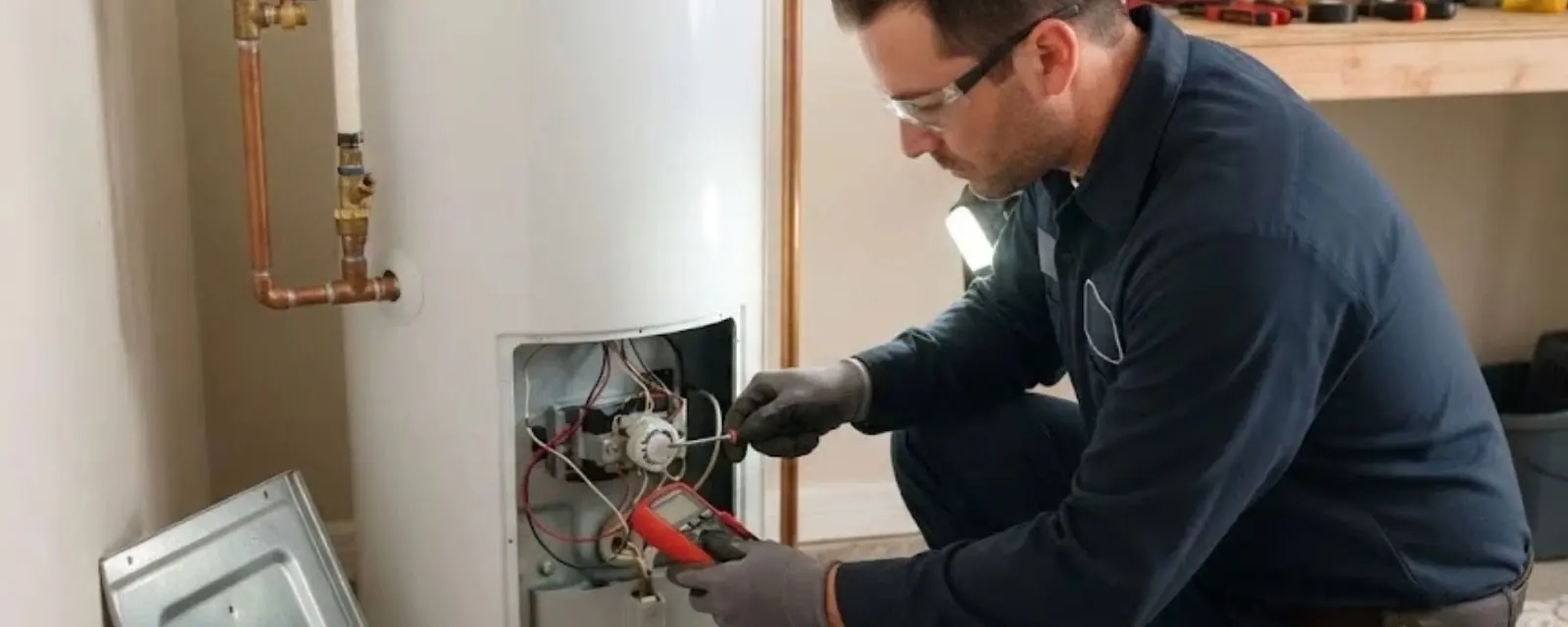
What the thermocouple actually does
A gas tank heater keeps a tiny standing flame called the pilot. The thermocouple is a short metal rod held in that flame, and the heat makes it generate a very small electrical signal. That signal holds the gas valve open.
If the flame goes out, the rod cools, the signal drops, and the valve closes on its own. That is the whole point of the part. It stops raw gas from flowing into the room when nothing is burning.
Over time the tip gets coated with soot or the metal fatigues and the signal weakens. The pilot then lights fine while you hold the button, but the valve drops out a few seconds after you release it.
Signs the thermocouple is the problem
Symptoms that point to the probe
- The pilot lights while you hold the control knob down, then goes out within seconds of letting go.
- The pilot flame looks weak, yellow or lazy instead of a steady blue flame touching the tip of the probe.
- The heater ran fine yesterday and you have relit it more than once this week.
- The tip of the probe looks black, bent or crusted when you shine a flashlight at it.
- There is no gas smell and no sign of scorching around the base of the heater.
If every item on that list fits, you are in thermocouple territory. If any of them does not, keep reading, because several other parts can mimic the same behavior.
How to replace it if you are comfortable doing it
Start by turning the gas control to off and waiting several minutes so any leftover gas clears. Close the gas shutoff on the supply line to the heater. Take off the burner access panel so you can see the pilot assembly.
The thermocouple is held by one nut at the gas control valve and a small clip or bracket at the pilot. Loosen the nut by hand or with a small wrench, free the bracket, and slide the old probe out. Buy the exact replacement by the length and fitting marked on the old one or on the heater's data plate.
Seat the new probe in the same bracket so its tip sits in the pilot flame. Snug the nut at the gas valve and do not overtighten it, because the fitting is soft. Open the gas supply, then follow the lighting instructions printed on the heater label.
Before you close the panel, brush soapy water on the fitting you touched. Any bubbling means a leak, so shut the gas back off and call a licensed plumber instead of trying again.
When it is not the thermocouple
A fresh probe does not fix a heater with a different fault, and guessing wastes a weekend. The table lays out the common look-alikes and who should handle each one.
| What you see | Likely cause | Homeowner or plumber |
|---|---|---|
| Pilot will not light at all | Blocked pilot orifice or no gas reaching the valve | Plumber |
| Pilot stays lit but no hot water | Failed gas control valve or burner problem | Plumber |
| Pilot blows out in wind or when a door closes | Draft or poor combustion air | Plumber |
| Soot, scorch marks or flame rolling out of the base | Venting or combustion problem | Stop and call a plumber |
| Pilot lights, drops out, probe is black | Worn thermocouple | Homeowner can swap it if comfortable |
| Water pooling under the tank | Tank or fitting leak | Plumber, often a replacement |
Heaters tucked into garages and closets can also lose their pilot because of drafts or because lint and dust have clogged the air path. Cleaning around the base is fine, but do not stuff anything into the vent or the burner area.
Why a new probe sometimes fails again
If the pilot drops out again a few days after a clean swap, something else is feeding the problem. A dirty pilot tube starves the flame, a loose bracket moves the tip out of the heat, and a failing gas control valve can ignore a perfectly good signal.
Sediment inside an old tank also makes the burner run longer and hotter at the bottom, which cooks components near the flame. At that stage a repair visit is worth it only if the tank itself is sound. A gas water heater repair visit tells you which path makes sense.
Try yourself
Relight per the label, clean visible dust from around the base, and replace a clearly blackened probe if you are comfortable with tools.
Call a plumber
Any gas smell after you have been cleared by the utility, a leaking fitting, soot, scorching, a pilot that will not stay lit after a new probe, or a controller that clicks without heating.
Call the gas utility or 911
A gas smell at any time. Leave the building first and make the call from outside.
Repair or replace the whole heater
A thermocouple is cheap, but it is not always the right place to spend effort. If the tank is leaking, rusted at the base or has been limping for years, the new probe only buys a short delay. Moisture around the bottom seam almost always means the tank is finished.
When the heater is old and also needs a gas valve or burner work, the repair total can approach the cost of a new unit. Ask for the clear price before work starts on both options and compare them side by side. Our team lays out the water heater replacement option next to the repair so you are not guessing.
Gas heaters and permits in Jacksonville Beach
Jacksonville Beach asks for a plumbing e-permit through its Building Inspection Division, and the application has a classification for fuel gas work and a field for whether the gas source is natural or propane. That means a simple relight or probe swap is one thing, but changing gas piping or replacing the heater may need a permit approved and posted before work starts. Ask the Building Inspection Division what applies before you open anything beyond the access panel.
The city also sits at or near sea level and has hurricane season from June 1 to November 30. After a storm, moisture, debris or a power event can disturb a heater in a garage or closet, so if a heater has been exposed to flooding, do not relight it yourself. Flood-exposed gas controls need a licensed plumber to inspect them first.
Quick safety checklist before you relight
- Smell the area first. Any gas odor means leaving and calling the gas utility or 911 from outside.
- Keep the area clear of paper, paint, gasoline, cleaners and anything flammable.
- Read the lighting instructions on the label and follow them in order.
- Never bypass or jumper a safety control to keep the pilot going.
- Stop if the pilot still will not hold after a fresh probe and call a licensed plumber.
A gas water heater is covered by the manufacturer's standards and the Fuel Gas volume of the Florida Building Code, which is why a pilot that will not stay lit is a safety item. If you smell gas, leave and call your gas utility or 911.
Pilot still dropping out?
Our licensed plumbers diagnose the valve, the burner and the flue, and we give a clear price before work starts. Same-day appointments are available when the schedule allows, and the line is open 24/7 for emergencies. Call now.
If you live just up the beach, the same crew handles plumbing calls in Neptune Beach, and the rest of our coverage is on the service area page.
Quick answers for Jacksonville Beach homeowners
The classic sign is a pilot that lights while you hold the knob and goes out after you release it. A blackened or bent tip points the same direction.
If the pilot will not light at all, or there is any gas smell, it is a different problem and a plumber should look at it.
No. Turn the control to off, close the supply shutoff to the heater and wait for residual gas to clear before touching the fitting.
After the new probe is in, open the supply and test the fitting with soapy water for bubbles.
Stop, leave the home with everyone inside, and call your gas utility or 911 from outside before you call a plumber. Do not use switches, lighters or phones inside.
Come back only when the utility confirms it is safe, then have the work finished by a licensed plumber.
They are related but not the same. A thermocouple holds the gas valve open with a small signal, while a thermopile makes a larger one and powers some gas controls.
The label on your control valve tells you which type it uses, and the replacement part has to match.
The city's plumbing e-permit has a fuel gas classification, and work cannot begin until a permit is approved and posted. Whether a simple part swap needs one is a question for the Building Inspection Division at 904-247-6100.
A licensed plumber will tell you what the job requires and handle the paperwork for anything beyond a relight.
Not sure which part has failed, or you smell gas after clearing the area with the utility? Our licensed team can take it from there.
☎ (904) 561-8133