
Start with the symptom, not the product
| What you notice | Likely need | Why |
|---|---|---|
| White crust on faucets and showerheads | Softener or scale control | The minerals leave deposits as water dries |
| Rotten-egg smell from hot or cold taps | Carbon or specialized filter, plus a check of the heater | Sulfur compounds cause the odor |
| Chlorine taste or smell | Carbon filter | Carbon adsorbs the taste and odor |
| Cloudy water or grit in aerators | Sediment filter | It catches particles |
| Drinking water you want extra clean | Reverse osmosis at one tap | It filters finely at the point of use |
| Spotty dishes and dry skin | Test first | Several causes look alike |
Notice how many rows lead to a test rather than a purchase. That is intentional. Three or four different problems can produce similar signs, and equipment that solves the wrong one does nothing.
What a softener does and does not do
A softener uses a bed of resin beads that trap hardness minerals and release sodium or potassium in exchange. The resin is cleaned periodically with a salt brine, which is why the tank needs refills of salt or potassium.
Softeners protect fixtures, water heaters and appliances from scale. They do not remove chlorine, odor or bacteria, and they do not make water safe to drink on their own. A softener also needs a drain connection to carry its rinse water away.
What a filter does and does not do
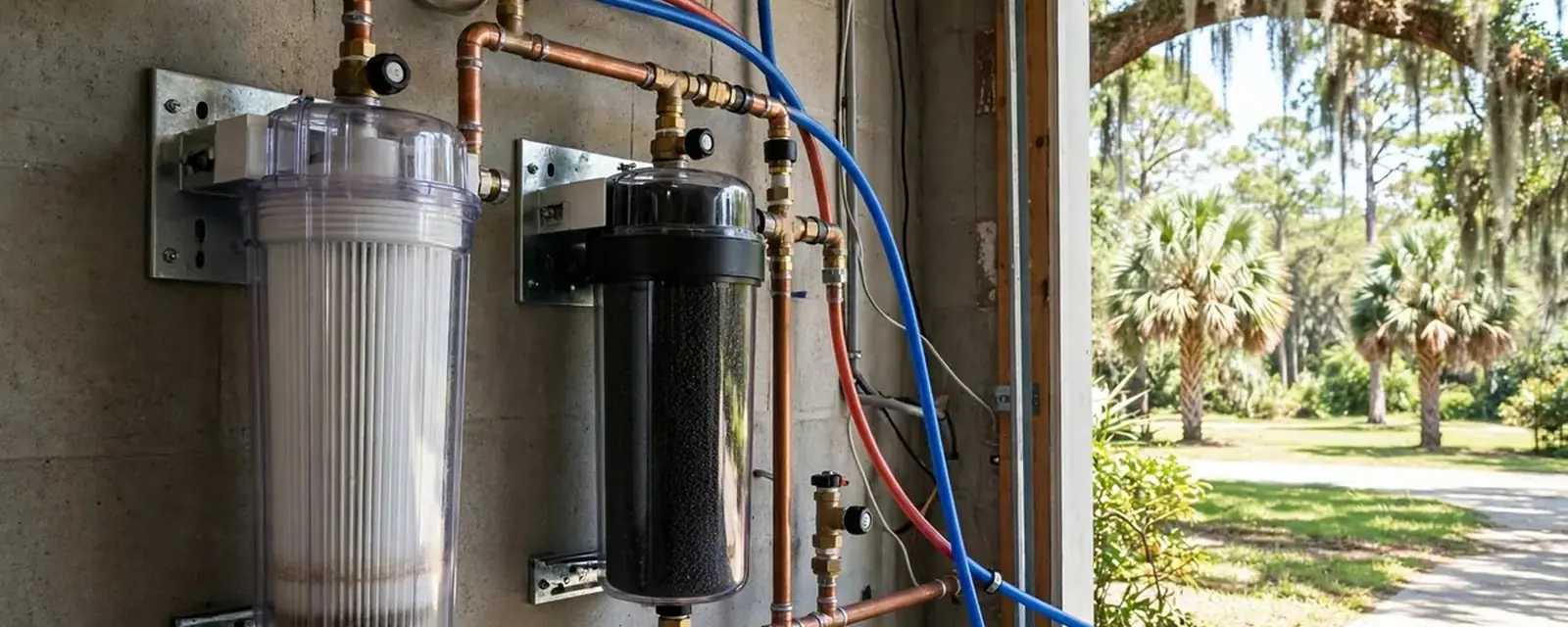
A whole-house filter sits where the water enters the home and cleans everything downstream. Sediment cartridges catch grit. Carbon media improve taste and smell by removing chlorine compounds and some organics.
A filter does not stop scale. Cartridges need changing on schedule, or they clog and cut your water pressure. If your pressure drops after a few months, a tired cartridge is the first thing to check.
Where reverse osmosis fits
A reverse osmosis system is usually a small unit under the kitchen sink with its own faucet. Water is pushed through a very fine membrane, and the cleaner water goes to a small tank. It makes a small volume of very clean drinking and cooking water.
It is not made for the whole house. It wastes some water as it works, and its membrane and filters need replacing on schedule. It pairs well with a whole-house system, not as a substitute for one.
Test your tap before you spend a dollar
How to test
- Buy a basic test kit or send a sample to a certified water lab and keep the printed results.
- Test both cold and hot water, because a smell that only shows on the hot side points to the water heater.
- Write down what you see on fixtures and when the problem happens.
- Ask your water utility for its annual water quality report and compare it to your own results.
- Show the results to a plumber before choosing equipment.
If the results show nothing out of range and the issue is only taste, a simple carbon filter may be enough. A softener and filtration consult starts with the test and a clear price before work starts, not with a sales pitch.
What Jacksonville Beach city water tells you, and what it does not
The City of Jacksonville Beach supplies its own water from six wells drawing on the Floridan Aquifer. The city aerates the water to remove hydrogen sulfide, which is the rotten-egg smell, and then chlorinates it for disinfection. If you still notice a sulfur smell at one tap, a plumber should check the water heater and the plumbing at that fixture, because the city already treats for it at the plant.
The city's 2025 water quality report lists lead and copper results with zero sites above the action level. It does not state hardness, so we will not guess a figure for your house. To find out how hard your water is, test the tap and ask the Water Division at 904-247-6241 for the annual report. Do that before choosing a softener, because that result decides whether you need one.
Also decide where the equipment will live. A softener and a whole-house filter need floor space near the main line, a drain, and an outlet for the softener control head. Garages and utility closets work well, as long as you can reach the unit to add salt and swap cartridges without moving boxes.
Water heaters and softened water
Mineral buildup coats the inside of a tank and the heat exchanger in a tankless unit, which makes them work harder and age sooner. That is the usual argument for a softener. A flush and descale schedule is another way to slow the damage.
If you plan a new heater, install any treatment equipment first or at the same time. Our water heater installation team can set the supply, the shutoff valves and the drain connection with that in mind.
What you can do and when to call
Do yourself
Test the tap, clean aerators and showerheads with vinegar, change filter cartridges on schedule and top off softener salt.
Call a plumber
Installing a system on the main line, tying into a drain, adding a bypass, a leak at the unit or pressure that drops after the install.
Call the water utility
Cloudy water that affects the whole neighborhood, or questions about the city's report and treatment.
Ask a pro first
If you rent or are in a community with rules about changing plumbing, check before installing anything.
Permits and installation
Treatment equipment ties into the water line and the drain, so it counts as plumbing work. The city's plumbing e-permit application asks for the work classification and says work may not begin until a permit is approved and posted. Ask the Building Inspection Division at 904-247-6100 whether your project needs one.
A licensed plumber will handle the connection, a bypass valve so you can service the unit and a proper drain break so the softener rinse water cannot flow back into your supply.
Both devices connect to the water supply under the IPC based Florida Building Code, Plumbing, and a softener drain must be a protected connection. Check with the city building division whether your install needs a permit.
Not sure what your water needs?
We start with a test and a conversation, then give you a clear price before work starts. Same-day appointments are available when the schedule allows.
Homes in Neptune Beach can book the same visit.
Quick answers for Jacksonville Beach homeowners
It depends on what your tap water does, and city water can still leave scale. Test your tap and read the water report. Do not buy a softener because of a neighbor's advice.
If the test shows low mineral content, a softener may not be needed.
Most filters do not. Sediment and carbon filters remove particles, taste and odor, not the minerals that cause scale.
Some scale control devices exist, but a softener is the standard way to remove hardness minerals.
They do different jobs. Reverse osmosis cleans a small amount of drinking water at one tap. A whole-house filter treats all the water entering the home.
Many homes use both.
Follow the manufacturer's schedule, and replace sooner if pressure drops or the taste returns. A clogged cartridge hurts flow.
Mark the date on the housing so you do not rely on memory.
No. The city's report lists lead, copper and other results but does not state hardness. To learn your number, test the tap yourself or ask the Water Division at 904-247-6241.
Use that result to decide whether a softener makes sense.
If the test results leave you with questions, a licensed plumber can walk through them and suggest the simplest fix.
☎ (904) 561-8133