
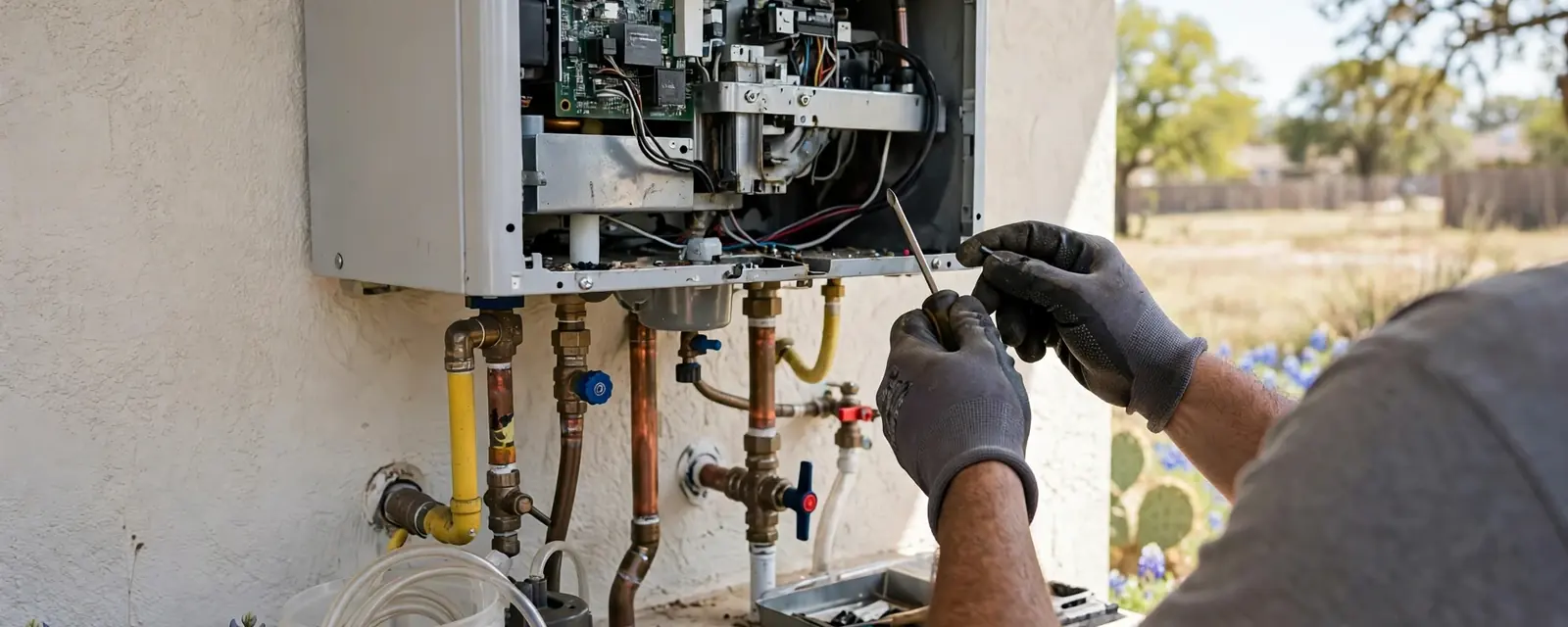
Symptoms that mean your tankless heater needs attention
A tankless unit has no tank to hide a problem. When something goes wrong, you feel it right away at the tap. The pattern of the symptom usually points at the cause, so describe it to the dispatcher in as much detail as you can.
| Symptom | Common cause | What we check |
|---|---|---|
| Water swings between hot and cold | Scale on the heat exchanger or a flow sensor reading wrong | Flow rate, inlet screen, heat exchanger condition |
| Error code on the display | Ignition, flame, vent or sensor fault | The code itself, vent route, gas or power supply |
| Weak hot water flow, cold flow is normal | Clogged inlet filter or scale restricting the exchanger | Inlet screen, isolation valves, flush condition |
| Hot water takes a long time to arrive | Distance from heater to fixture, or no recirculation | Pipe run, recirculation pump if fitted |
| Unit shuts off mid-shower | Low flow, overheating, a venting issue | Flow switch, temperature sensors, vent and exhaust |
| Pilot or ignition clicks but no flame (gas) | Gas supply, igniter or flame sensor | Gas pressure, igniter, burner area |
Flushing and descaling: what it is and why it matters here
A flush circulates a descaling solution through the heat exchanger so mineral buildup dissolves and leaves with the water. We isolate the unit with service valves, run the solution through with a small pump, rinse the unit and clean the inlet screen. When the exchanger is clean, the heater heats faster and runs closer to its design flow.
Chlorinated groundwater, and why we do not guess at scale
Jacksonville Beach supplies its own water from six wells in the Floridan Aquifer. The city aerates it to remove hydrogen sulfide and chlorinates it for disinfection. Chlorine in the water does not build scale, minerals do, and the city's published water quality report does not state a hardness figure for the system.
That is why we do not give a fixed flush interval. Test your tap, ask the Water Division for the annual report at 904-247-6241, and we set a schedule from what we find in your exchanger. If we find heavy scale after a short period, a water softener or filtration system may be the better long-term fix than flushing more often.
Tankless repair: gas, electric and condensing units
Gas tankless units have more moving parts than electric ones. We service igniters, flame sensors, gas valves, fans and condensate traps on condensing models. Electric units trade the burner for heating elements and a high-amperage circuit, and failures there tend to be elements, relays or a tripped breaker.
We read the error code first, then confirm it by testing the part that code points to. Replacing parts blindly gets expensive on a tankless heater, so a diagnosis comes before parts. If the unit is far past what a repair can justify, we say so and talk through water heater replacement options.
Installing a tankless heater: the pieces a tank swap does not have
Tankless installs are not a tank swap with a smaller box. A gas unit often needs a larger gas line than the old tank did. The vent is a different material and route. An electric unit may need a dedicated heavy circuit. Condensing units need a place for condensate to drain.
What we confirm before quoting a tankless install
- Gas line size and meter capacity, or panel capacity and circuit size for electric.
- Vent route to outside and clearances for exhaust.
- Water supply pressure and flow at the fixtures that matter to you.
- Condensate drain location for condensing models.
- Whether a recirculation loop or point-of-use unit solves long waits at distant fixtures.
- The city plumbing e-permit classification, which our water heater installation page explains.
A tankless install touches several codes at once. Water, venting and gas supply sizing follow the Florida Building Code, Plumbing, drawn from the International Plumbing Code (IPC) plus the Fuel Gas volume of the Florida Building Code, and the manufacturer's instructions add their own limits.
Tankless heater acting up?
Call now with the error code or the symptom, and a dispatcher will book a licensed plumber for a same-day look when the schedule allows.
What affects tankless service and install cost
A flush and a full installation are very different jobs, so we do not post a single number. You get a clear price before work starts.
Homeowner insurance usually covers sudden and accidental water damage, not worn parts or gradual leaks. Save your error codes, photographs and receipts if a claim is possible.
Give the dispatcher the model and the symptom and we will talk through the likely scope.
Tankless Water Heater Service questions in Jacksonville Beach
The city's water quality report does not state hardness, so we do not give a one-size interval. Test your tap, then let a plumber look at the exchanger on the first service. We set the schedule from what is actually inside.
Codes point to ignition, flame, vent or sensor faults. Write the code down before you reset anything. A plumber can tell you whether it is a simple cleaning or a failed part.
Often the exchanger has scale or the flow is too low for the unit to hold temperature. Cleaning the inlet screen and flushing the unit solves many cases. Others need a flow or sensor check.
The city chlorinates for disinfection, but it is minerals in the water, not chlorine, that normally build scale. We test and inspect before blaming either.
Usually, though gas supply, vent and electrical needs differ. A site visit decides whether the home can take the conversion without major changes.
Tankless eliminates standby storage, but water still has to travel the pipe run. A recirculation setup or a point-of-use unit near the far fixture can help.
Send us the model and the symptom and a plumber will take it from there.
☎ (904) 561-8133