
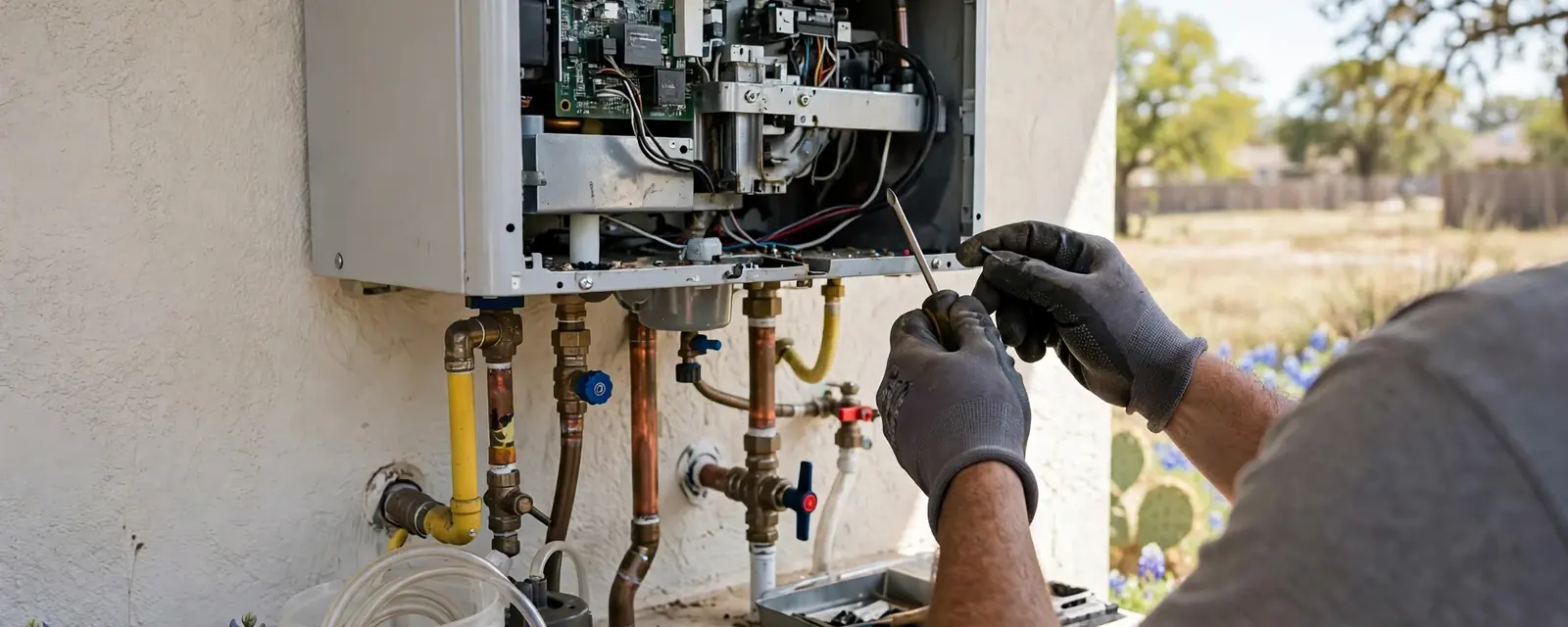
How the heating actually happens
When you open a hot tap, a flow sensor inside the unit notices water moving and tells the controller to fire. A gas model lights a burner under a heat exchanger. An electric model energizes elements that sit in the water path.
The unit then adjusts its output to hit the temperature you set. If you shut the tap, the sensor drops out and the heater stops. There is no standing pool of hot water, so there is no standby loss from a big insulated tank.
The limit is how much heat the unit can add per minute. That ceiling decides how many showers, dishwashers and washing machines can run before the water at the farthest fixture turns lukewarm.
Gas versus electric
| Factor | Gas tankless | Electric tankless |
|---|---|---|
| Heating power | Higher output, handles several fixtures at once | Lower output per unit, best for a bathroom or small home |
| What the house needs | Gas line sized for the burner, venting through wall or roof, combustion air | Large dedicated electrical circuits and spare capacity in the panel |
| Installation work | Gas piping, vent, condensate drain on condensing models | Heavy wiring, no vent |
| Typical fit | Whole-house use, families, back-to-back showers | Single bathroom, apartment, point-of-use |
| Permit angle | Fuel gas classification on the city form plus plumbing work | Plumbing work, with electrical handled separately |
Many Florida homes already have a gas line for a stove or a dryer, but the pipe may be too small for a tankless burner. A plumber checks the pipe size and run length before quoting the job, not after.
Electric units look easier because there is no vent, but the wiring demand is large. If your panel is already full, the electrical upgrade can matter more than the heater.
Who a tankless heater fits well
Households with long gaps in hot water use
A vacation rental, a second home or an empty-nest house stops paying to keep a tank hot all day.
Homes short on space
A wall-mounted unit frees up a closet or garage corner.
Families tired of cold showers
The supply does not run out, though the flow rate still limits how many fixtures run at once.
Homes with a sound gas supply
The best candidates already have the pipe size, vent route and clearances a gas burner needs.
Who should think twice
A house with a small gas line, a crowded panel or no practical route for a vent will pay more to prepare for a tankless unit. Sometimes a modern tank unit is the better answer for that home.
Households that run several showers, a washer and a dishwasher together can overwhelm a single unit. A second unit or a larger model can help, but that changes the budget conversation. A plumber can size it against how your family really uses water.
Water temperature and flow, the two things people notice
Tankless heaters have a minimum flow before they ignite. If you crack a tap barely open, the unit may not fire and you get cold water. That is normal behavior, not a defect.
The other quirk is the cold water sandwich. After a short shutoff, the water in the pipe cools while the heater restarts, and you feel a brief cold burst. Longer pipe runs make it worse, and a recirculation setup can reduce it.
What you can do and what to call about
Homeowner checklist
- Check that the gas supply valve or the breaker is on before assuming the unit has failed.
- Read the error code on the display and write it down. It narrows the problem quickly.
- Clean the inlet screen if the manual shows how, after shutting off the water and power.
- Keep the area around the unit and the vent clear of storage.
- Schedule a descale flush if your tap water leaves mineral buildup in kettles and fixtures.
Call a licensed plumber for any gas smell after the utility has cleared the home, for ignition failures that repeat, for water temperature swings you cannot explain, and for any installation. Gas piping, venting and the water connection should be done by someone who can pull the permit.
That is the kind of work behind our tankless water heater service, which covers installs, repairs and flushes. We give a clear price before work starts.
Planning a swap from a tank heater
Converting from a tank to a tankless unit is a bigger job than swapping like for like. The old tank is drained and removed, the water connections are reworked, and the gas pipe and vent are brought to the new location. Sometimes an electrical outlet is needed for the controller.
If you are weighing every option for the install, our page on water heater installation explains how we plan the connection, the venting and the permit steps.
What the city process means for your install
The City of Jacksonville Beach handles plumbing work through a plumbing e-permit. The application asks for the classification (alteration, new, re-pipe, repair, fuel gas or other), whether the water source is city or well, and whether the gas source is natural or propane. A tankless install normally touches the gas source and the water connection, so tell your plumber which fuel you have before the permit is filed.
The application states that work may not begin until a permit is approved and posted on site. If you are doing your own work, the city has different signature requirements and an Owner Builder Disclosure Statement, so call the Building Inspection Division at 904-247-6100 before you buy equipment. The city plans follow the Florida Building Code 2023 edition, and a licensed plumber knows how that affects vent and clearance choices.
Questions to ask before you buy
- Is my gas line big enough, and can the vent run the way the unit requires?
- Does the unit need a condensate drain, and where will it empty?
- How many fixtures can it supply at once in my home?
- What will the installer do if the permit inspection finds a problem?
- Does the warranty require a periodic flush, and who handles that?
Sizing the gas line, vent and water connections for a tankless unit follows the manufacturer's installation standards and the IPC based Florida Building Code, Plumbing along with its fuel gas volume.
Ready to size a tankless unit?
We will look at your gas line, your vent route and how your household uses hot water, then give you a clear price before work starts. Same-day appointments are available when the schedule allows.
If you live in the next town over, we also dispatch to Neptune Beach homes with the same licensed crews.
Quick answers for Jacksonville Beach homeowners
It can be if you value continuous hot water and wall space, and if your gas line or panel is ready for it. It is less appealing when the house needs expensive gas or electrical upgrades first.
A plumber can compare it against a new tank unit for your house before you decide.
Yes. Mineral buildup can coat the heat exchanger, so a periodic flush is part of normal care. Cleaning the inlet screen and keeping the vent clear matter too.
Skipping that care is a common reason for error codes and weak flow.
Each unit has a maximum rate it can heat. When too many fixtures draw at once, the unit cannot lift all of that water to the set temperature.
Lowering demand fixes it for the moment. A larger model or a second unit fixes it for good.
Often yes, as long as the unit gets the clearances, combustion air and vent route the manufacturer requires. Freeze is rarely a concern in this area, but the installer still follows the model's instructions.
A garage location also lets you keep the water lines short if the bathrooms are close.
The city's plumbing e-permit asks for the classification of work and the gas source, and says work may not begin until a permit is approved and posted. Call the Building Inspection Division at 904-247-6100 to confirm what your project needs.
A licensed plumber can file it and schedule the inspection for you.
If you want a straight answer on whether tankless fits your house, a licensed plumber can look at the gas line and the layout and tell you.
☎ (904) 561-8133