
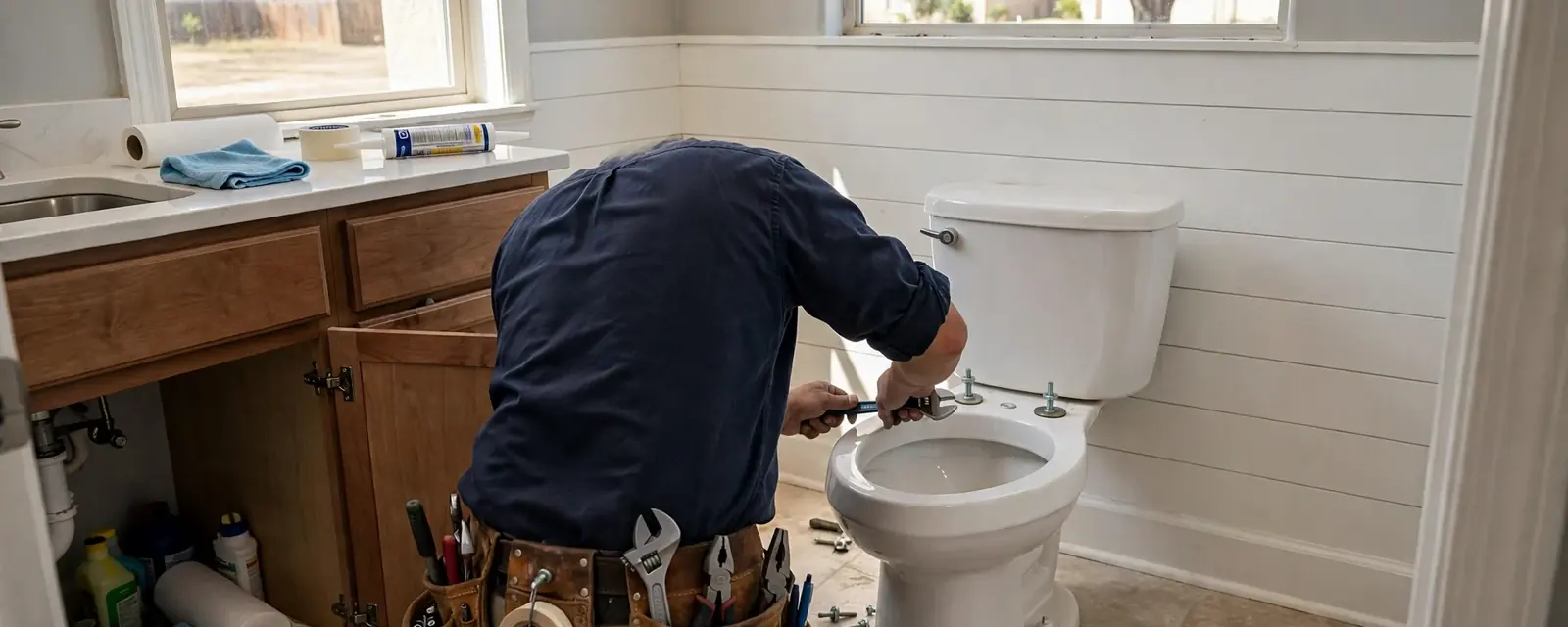
Start with what is going down the bowl
Toilets are built for human waste and toilet paper. Everything else is a gamble. Wipes labeled flushable do not break down the way paper does, and they hang on rough spots in the pipe until they form a plug.
Paper towels, cotton swabs, dental floss, hair, feminine products and cat litter cause the same trouble. If a toilet clogs once a week and a household member uses wipes, the wipes are the first suspect.
| Item | Flush it? | Why |
|---|---|---|
| Human waste and toilet paper | Yes | Designed to break down in moving water |
| Flushable wipes | No | They hold together and snag in the line |
| Paper towels and tissues | No | Thicker, slower to break down |
| Cotton swabs and floss | No | They tangle and catch other waste |
| Hygiene products | No | They swell and block bends |
| Cat litter and food scraps | No | They settle and harden in the trap |
A weak flush is a cause, not a symptom
A toilet moves waste by dumping a rush of water into the bowl fast enough to fill the trapway and siphon everything out. If the tank is not delivering enough water, the siphon never fully forms, and waste lingers in the trap.
Inside the tank, check the fill level against the line marked on the overflow tube. A low water level, a flapper that closes too soon or a chain with too much slack all shorten the flush. Mineral buildup can also clog the small rim holes under the bowl lip, which slows the water that washes the bowl.
Quick tank checks
- Lift the lid and compare the water level to the fill line on the tank wall.
- Look at the chain. It should have a little slack, not too much and not too little.
- Watch the flapper close. If it drops early, the flush ends before the bowl clears.
- Run your finger along the rim holes and clear any rough mineral crust.
- Flush once and watch for a strong, full swirl rather than a trickle.
When the flange or the seal is the problem
The flange is the ring on the floor that connects the toilet to the drain. If it sits too low, too high or has cracked, the toilet can rock slightly and the seal at the bottom leaks or the opening is partly blocked. A worn wax ring can cause the same trouble.
Warning signs include a toilet that wobbles, water around the base after a flush, a sewer odor in the bathroom and a stain on the floor or the ceiling below. These are plumber jobs because the toilet has to be pulled to inspect the flange. Our toilet repair work covers a reset, a new wax ring or a flange fix.
When the vent or the drain line is behind it
Every drain needs air behind the water so the flush does not pull a vacuum. A blocked vent pipe on the roof slows the drain, causes gurgling in nearby fixtures and makes a toilet clog or flush with a loud glug.
If the toilet is slow, the tub gurgles when you flush and a floor drain nearby smells, the blockage may be in the branch line or the main drain. A single plunger session will not cure that. A cable or a camera inspection will show where the problem sits.
A recurring clog on the lowest toilet in the house, especially if sinks and showers also back up, can mean the main line is partly blocked. That is when a drain cleaning visit makes more sense than another plunger.
What you can safely do yourself
Plunge correctly
Use a flange plunger that seals the bowl outlet. Push gently first to expel the air, then pull and push in steady strokes.
Use a closet auger
A short toilet auger reaches the trap without scratching the porcelain. Crank slowly and do not force it.
Fix the tank
Adjust the chain, clean the rim holes and replace a tired flapper if the flush is weak.
Stop the chemicals
Skip drain acids. They do not clear toilets well and they are hard on pipes, fittings and anyone who has to work on the line later.
When to stop and call
Call a licensed plumber if you have plunged and augered twice without lasting results, if more than one fixture backs up, if the toilet wobbles or leaks at the base, or if the clog returns within days. Also stop if wastewater is rising in a tub or shower.
A toilet that overflows should be handled in order. Close the shutoff valve behind the bowl, stop adding water and lift the tank flapper by hand to prevent more water entering. After that, work on the clog, not before.
City side versus your side of the line
The City of Jacksonville Beach provides water and sewer itself through its Water Division, and the water and sewer office is at 904-247-6241 weekdays from 8:00 to 4:30. If several homes on your street are backing up at once, or you see sewage coming up in the street, that points to the city's sewer main. Call the city emergency line listed for water and sewer at 904-247-6278 so crews can check the main.
If only your house is affected and the toilet clogs repeatedly, the problem is usually inside your property line, which is the plumber's side. About two-thirds of the municipal area is water and the land sits at or near sea level. That is a reason to take a slow drain seriously during heavy rain, because a sluggish line has less room to recover when the system is under strain.
Keeping it from coming back
- Put a small wastebasket next to the toilet and tell guests that only paper goes down.
- Use less paper per flush. Two flushes beat one clog.
- Replace a tired flapper or fill valve rather than living with a weak flush.
- Flush after a long vacation to refresh the trap before guests arrive.
- Book a camera look at the line if the toilet has clogged more than twice in a month.
If the cause is a vent or drain line, the fix has to meet the IPC based Florida Building Code, Plumbing, and a plumber should confirm slope and venting rather than only clearing the stoppage.
Tired of plunging?
Our licensed plumbers find the cause instead of clearing the symptom, and we give a clear price before work starts. Same-day appointments are available when the schedule allows.
We also dispatch to Neptune Beach when a toilet or drain needs help in the next town.
Quick answers for Jacksonville Beach homeowners
A weak flush is the most common reason. Check the tank water level, the flapper and the rim holes. If those look fine, the flange, the vent or a partial blockage in the drain may be to blame.
Two clogs in a week from paper alone is a sign to have the line looked at.
We advise against it. Chemical cleaners rarely clear a solid clog, they sit in the bowl and they are dangerous for anyone who then plunges or removes the toilet.
A plunger, a closet auger or a plumber is the safer path.
If only one toilet is slow, the problem is likely local to that toilet or its branch. If a tub, sink or floor drain also gurgles or backs up, the main drain is the likely cause.
Another sign is water rising in a shower when you flush.
Yes. A blocked vent slows the flush and causes gurgling and slow draining. It often shows up in several fixtures rather than one.
A plumber can test airflow and clear the vent or find where it is blocked.
Sewage in the street points to the city main, so call the city water and sewer emergency line at 904-247-6278. If the problem is only inside your house, a licensed plumber handles it.
If you are not sure which side the problem is on, a plumber can tell by checking the cleanout.
If your toilet keeps clogging after you have done the checks above, a licensed plumber can find the real cause.
☎ (904) 561-8133