
Why the main line backs up first at the lowest drain
Wastewater from the whole house runs to one pipe, and gravity moves it. When that pipe is restricted, water finds the lowest opening, which is usually a floor drain, a shower or a ground-floor toilet. If upstairs fixtures are fine and the lowest ones overflow, the blockage is almost certainly in the main.
That is the signal to stop using the plumbing. Every flush sends more water into a pipe that cannot take it, and the overflow ends up on your floor.
Low ground and old lateral lines: the local problem
San Pablo Island sits at sea level
Jacksonville Beach sits on San Pablo Island, with land at or near sea level and about two-thirds of the municipal area made up of water. Ground that low tends to stay wet, and that matters for sewer lines in two ways. Wet soil lets tree and palm roots reach pipe joints easily, and it can soften the bedding a pipe rests on, which leads to sags that collect solids.
The practical advice is to treat a repeat backup as a sign to look, not just clear. A line that fills after heavy rain, or after a storm surge in hurricane season, may have a belly or a joint that lets water in. If that is what we see on camera, we will show you and explain the options.
Finding your cleanout and why it matters
A cleanout is a capped pipe that gives direct access to the main line. It is usually a round cap near the house wall, in the yard or beside the driveway, sometimes in a garage or a utility room. Having one turns an hour of dismantling a toilet into a quick cable run.
How to locate it before we arrive
- Walk the outside wall nearest the bathrooms and look for a capped pipe about three or four inches across.
- Check along the line between the house and the street, since some are set just above grade.
- Clear leaves, mulch and debris around the cap so the plumber can reach it.
- If you cannot find one, tell us. We can work through a toilet or another access point, though it takes more time.
City main or private lateral? A short phone check
The sewer lateral from your house to the city connection is yours. The main in the street is the city's. If wastewater is rising in the street, or neighbors have the same backup, the City of Jacksonville Beach water and sewer emergency line is 904-247-6278. During weekday office hours the city office is 904-247-6241.
If only your house is affected, a plumber can clear the lateral and confirm that the city main is flowing past your connection. This saves a wasted call to the wrong party, and it tells us whether to cable toward the street or back toward the house.
| What you see | Likely owner | Who to call |
|---|---|---|
| Sewage coming up in one house only | Private lateral or house drain | A licensed plumber |
| Several homes backed up on the block | City main | City emergency line at 904-247-6278 |
| Wet spot in your yard along the lateral | Private lateral | A licensed plumber, with a camera inspection |
| Manhole overflowing in the street | City main | City emergency line |
Cleaning a sewer line also shows how the line sits against the code standard for Florida plumbing, the IPC based Florida Building Code, Plumbing. A cleanout that is missing or buried is a common finding, and adding one is a cheap way to make the next stoppage easier to clear.
A main line that will not drain
Call (904) 561-8133 for 24/7 dispatch. A licensed plumber will cable the main, tell you what caused the blockage and give a clear price before work begins.
How we clean a sewer line
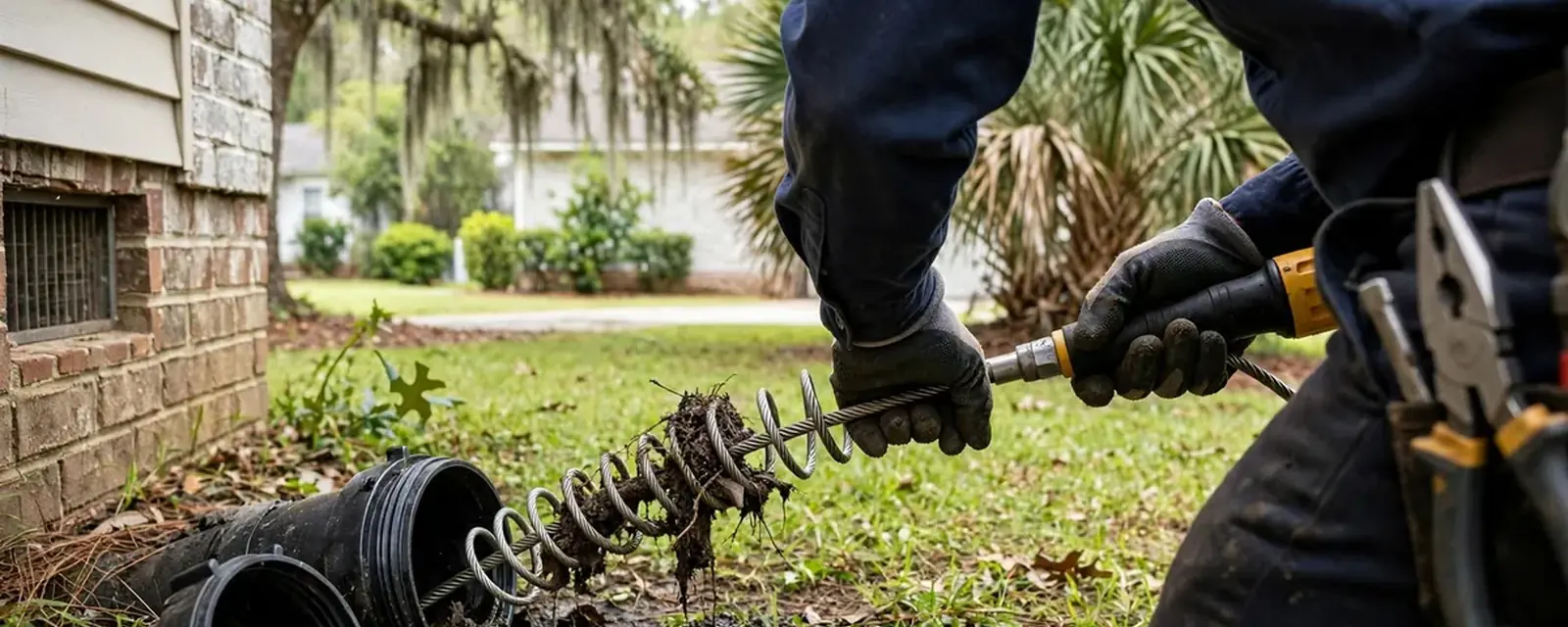
The first move is a cable machine fed through the cleanout. A cutting head spins through paper, wipes, grease and soft root growth until water flows, and the plumber checks that it runs freely downstream. Heavier buildups call for a bigger head, and tight root masses may call for a cutter.
When the line has a repeating coating of grease or fine roots, hydro jetting follows the cable. The jet scours the pipe, and the result lasts longer. If the cable keeps hitting the same obstruction, a camera runs next, and we move to sewer line repair if there is damage.
Habits that cause main line clogs
Flushable wipes
They do not break down like toilet paper and snag on roots and joint edges.
Grease down the kitchen drain
It cools and builds a rind along the pipe, and the main collects the debris.
Roots
Palms and shrubs near the lateral push into joints and grow into mats.
Sags in the pipe
A low spot holds water and solids, and the same blockage returns.
For a quick look at the drain side of things, see drain cleaning. For a planned look at the lateral, a camera inspection shows the pipe before the next backup.
What goes into a sewer cleaning price
You get a clear price before work starts. The plumber sets it after seeing the access and the symptoms.
Policies often cover sudden backup damage when an endorsement is in place, and they rarely cover the cost of the cleaning itself. Check your own policy and photograph damage before cleanup.
Call, describe what is backing up, and we will tell you what to expect.
Sewer Line Cleaning questions in Jacksonville Beach
Yes. Our dispatch is open 24/7, including weekends and holidays. A plumber will clear the main from the cleanout and tell you if the underlying cause needs more work, with a clear price before work starts.
If neighbors are backed up or sewage is in the street, call the city at 904-247-6278. If only your house is affected, call a plumber, since the lateral is on your side.
Yes, it can. Jacksonville Beach is low ground, so a lateral with a belly or a loose joint may fill during storms. A camera inspection shows whether the line is letting water in.
Look for a capped pipe near the house wall, in the yard along the sewer path, or in a garage or utility space. If you cannot find one, we can still work, but adding a cleanout may be worth discussing.
It depends on the cause. A one-time paper plug may never return. Roots, grease or a belly in the pipe will bring the problem back until the cause is dealt with.
Cleaning usually is not new piping work, but repairs may be. Ask the Building Inspection Division at 904-247-6100 and we will flag it before any repair.
If the main will not drain and water is rising, a call to dispatch starts the fix.
☎ (904) 561-8133