
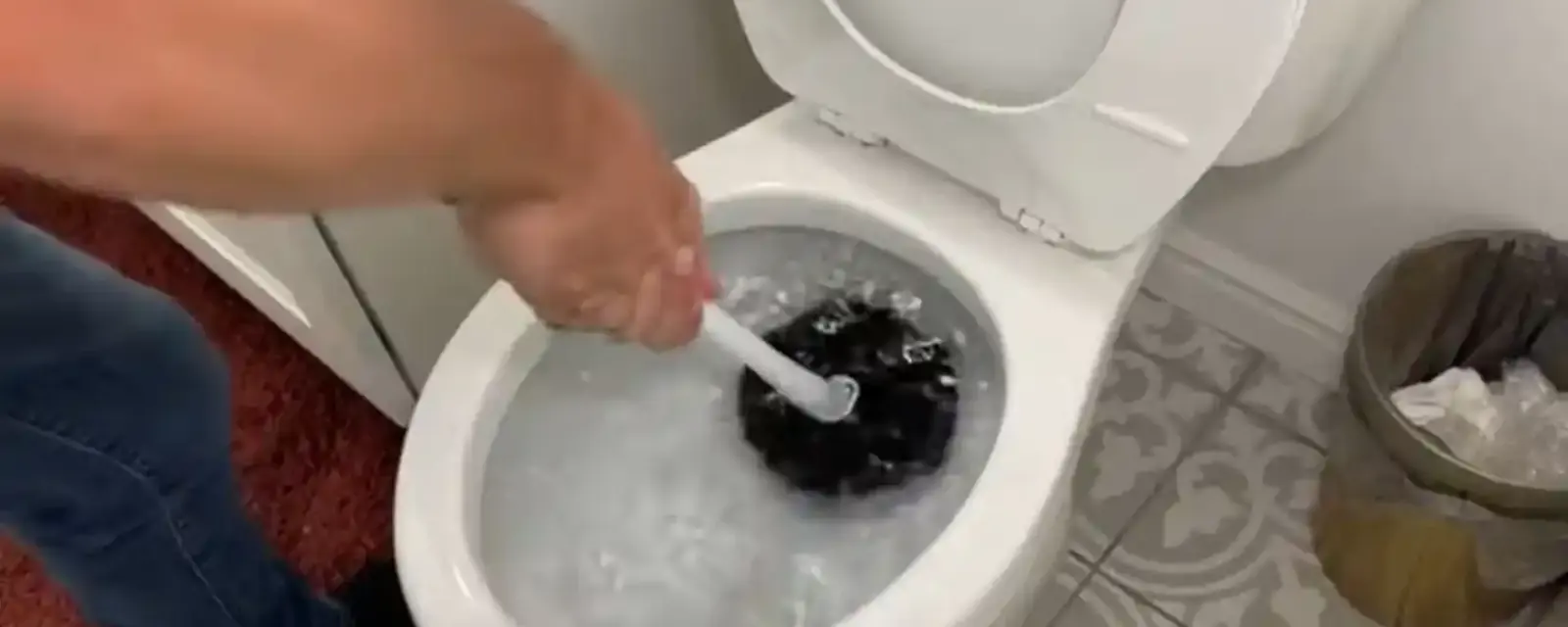
First, stop it from overflowing
If the water is rising, do not flush again. Take the tank lid off and push the flapper down into its seat to stop more water entering the bowl, or turn the small valve behind the toilet clockwise to shut off supply. Lay towels around the base and put a bucket nearby.
Wait a few minutes. Sometimes the water level drops by itself as the clog loosens. Resist the urge to try a second flush to see whether it works, since that is how a bathroom floor gets flooded.
Plunging the right way
Use a flange plunger, which has a soft rubber fold that fits the drain opening. A flat cup plunger made for sinks does not seal on a toilet. The bowl should have enough water to cover the plunger head. If it is low, add water from a bucket. If it is nearly overflowing, scoop some out first.
A plunging routine that works
- Seat the plunger fully over the drain opening and press down gently to push air out
- Plunge with short, steady strokes, keeping the seal tight
- Make about fifteen to twenty pushes before you lift the plunger to check
- Add a squirt of dish soap and hot (not boiling) tap water to help slip the blockage along
- Repeat the process two or three times before changing tools
- Flush once only after the bowl drains normally
Avoid boiling water. It can crack porcelain. Hot water from the tap is plenty.
When to switch to a closet auger
If plunging does nothing after a few tries, the clog is probably beyond the trap or lodged tightly. A closet auger is a short snake with a sleeve that protects the bowl. Feed the tip into the drain, crank the handle slowly and let the hook catch the blockage.
| Tool | Works best on | Stop if |
|---|---|---|
| Flange plunger | Paper and waste in a single toilet | Water keeps rising or nothing moves after several rounds |
| Closet auger | A clog stuck just past the trap | The auger hits a hard obstacle or stops turning |
| Camera or professional machine | Toys, wipes, roots, a stubborn plug | You suspect a main line or vent problem |
| Pulling the toilet | Retrieving an object or fixing a flange | You are unsure about the wax ring or flange |
Never force the auger if it binds. Back out, check what is on the tip and try again from a different angle. Pushing a cable against a hard object can scratch the bowl or scuff the trap. If a child's toy or a bottle cap is the culprit, the auger may only push it deeper.
Toilets in Florida are installed under the IPC based Florida Building Code, Plumbing, which also sets how a bowl is vented and drained. A clog that keeps returning after a plunger is often a venting or drain line question.
Plunger beaten and the bowl still full?
A licensed plumber can clear the line or pull the toilet if needed. Call now and tell our dispatcher whether other drains are also slow.
What never goes in the bowl
Wipes are the biggest repeat offender, including those sold as flushable. They do not break up like paper. Feminine products, cotton balls, dental floss, paper towels and kitty litter belong in the trash. Even thick toilet paper in big wads can overwhelm a low-flow bowl.
Chemical drain cleaners are a bad idea for a toilet. They can sit in the trap, damage the wax seal or the porcelain finish and splash back on whoever plunges next. If you used one already, tell the plumber before they start, so they can wear protection.
Signs the problem is not just the toilet
A single clogged toilet is local. A toilet that gurgles when the shower runs, a tub that bubbles when you flush, or sewage showing up in a floor drain points further down the line. Those are signs of a main drain or sewer blockage, and a plunger will not help.
| What you notice | Probably | Do this |
|---|---|---|
| Only one toilet is slow | Local clog | Plunge, then auger |
| Two bathrooms back up | Branch or main line | Stop using water, call a plumber |
| Water appears in a low tub or floor drain | Main line or sewer | Stop, keep water off, call |
| Gurgling after flushing | Vent or partial blockage | Call to inspect the vent and line |
| Toilet clogs again after a day or two | Flange, low flow or deeper obstruction | Call for repair or inspection |
For a main line backup, our sewer line cleaning service clears the line with a machine and checks what caused it. For a toilet that clogs over and over, the fix may be a new flange, wax ring or a corrected fill setting, which our toilet repair plumbers handle.
City sewer or your own pipe? Know who to call
The City of Jacksonville Beach runs its own water and sewer, so the dividing line is the property line. A blockage in the sewer main in the street is the city's to fix. A blockage inside your property is yours.
Because the town is low and flat and a lot of its area is water, a backup that hits several houses on one street is a strong hint the main is the cause. In that case call the city before paying a plumber to snake your line.
The city water and sewer office is 904-247-6241 on weekdays from 8:00 to 4:30, and its emergency line is 904-247-6278. If only your house is affected, call a plumber. Residents of Neptune Beach are served by their own city, so use City Hall at 904-270-2400 for the main in that town.
What to do while you wait for a plumber
Keep the water running in the house to a minimum. Showers, laundry and dishwasher cycles all send water toward the same line. Close the toilet lid and put towels at the base. If sewage is on the floor, keep children and pets away, wear gloves and avoid walking through it.
For insurance, photograph any damage before you clean it. Policies usually cover sudden and accidental discharge, not gradual leaks or the failed part itself, so check your own policy language. A plumber can document the cause.
Quick answers for Jacksonville Beach homeowners
A weak flush, an old low-flow model, a partial blockage further down the drain or a bad vent can all cause it. If the toilet clogs more than once a month with normal use, have a plumber check the flange, the bowl and the drain line.
Not without caution. The chemical may still be sitting in the water and can splash. Wear gloves and eye protection, and tell any plumber what you used.
Often the clog has nothing to do with it. A bad flapper, a stuck fill valve or a misadjusted float are the usual causes. They are fixable parts, and a plumber can replace them during the same visit.
When sewage is coming up in multiple fixtures, when the bowl keeps overflowing or when the only toilet in the home is out of service. For those, use our 24/7 emergency dispatch instead of waiting.
If a neighbor has the same problem, the sewer main may be the cause, and the city's water and sewer emergency line at 904-247-6278 is the first call. If only your home is affected, call a plumber to clear the line inside your property.
If the plunger and auger are not enough, our dispatcher can send a licensed plumber and sort out whether it is the toilet or the line.
☎ (904) 561-8133